

The Fantail cat tree guide
How to Choose the Right Cat Tree for Your Cat
A cat tree gives your cat a place to climb, scratch, rest and watch the room. This beginner-friendly guide explains which height, layout and features will suit your cat best.
What does a cat tree actually do?
A good cat tree supports the behaviours cats naturally repeat every day. Before choosing a model, it helps to understand why resting, watching, climbing and scratching all matter.
A comfortable place to rest
Cats spend a large part of the day resting. A basket, hammock or platform gives them their own secure place to settle. Cats that curl up often prefer a supportive basket, while cats that stretch may need a wider platform.

A clear view of the room
Many cats feel safer when they can observe the room from above. A raised resting place lets them watch people, other pets and movement without feeling directly involved.

A safe way to climb
The distance between levels should suit your cat. Kittens, senior cats and cautious climbers usually benefit from shorter steps, while confident adult cats may enjoy a taller route with more vertical movement.

A dedicated place to scratch
Scratching helps cats stretch, maintain their claws and mark their space. A useful scratching post should be easy to reach and tall enough for a comfortable full-body stretch.

How tall should your cat tree be?
The right height depends on your cat’s age, mobility, confidence and activity level. A taller tree is not automatically better—the easiest and safest route between levels is just as important.
Choose by answering these four questions
Kittens and senior cats often need easier access and shorter distances between levels.
Cautious cats may prefer lower resting places, while confident climbers can enjoy more height.
Energetic indoor cats usually benefit from more vertical movement and several levels.
For multi-cat households, wall-mounted Fantail configurations are a strong choice. They use vertical space efficiently and provide a sturdy shared setup.
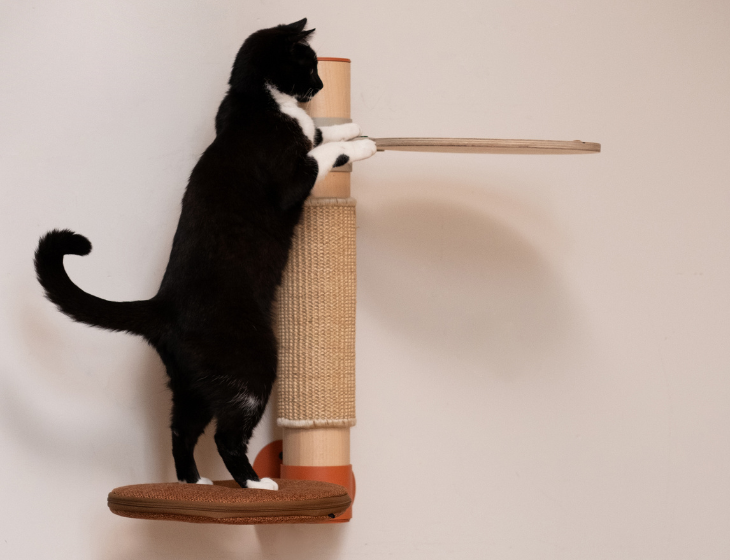
The Explorer · 60 cm
A lower Cat Tree for kittens, senior cats, cats with reduced mobility and cautious climbers. It keeps the resting area easy to reach and close to the floor.
Explore The Explorer
The Observer · 120 cm
A balanced choice for many adult indoor cats. It gives your cat a raised place to rest and watch the room without taking up the space of a very tall Cat Tree.
Explore The Observer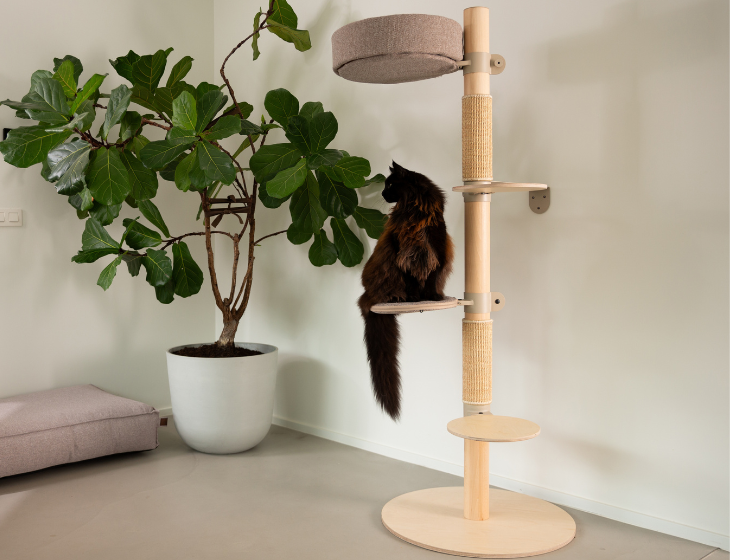
The Adventurer · 180 cm
A taller floor-standing configuration for confident climbers and active cats. For multi-cat households, consider Fantail’s wall-mounted configurations, which use vertical space efficiently and provide a sturdier shared setup.
Explore The AdventurerWhat is the Fantail Cat Tree made of?
The Fantail Cat Tree combines solid wood, Fantail steel, sisal and washable, replaceable recycled-fabric covers. Each material has a practical role in how the tree feels, performs and lasts.
Solid wood gives the Cat Tree its foundation.
The wooden parts provide the main structure and give the Cat Tree a warm, furniture-like feel. They are designed to support everyday climbing, resting and movement.
Fantail steel keeps the structure stable.
The steel connections hold the different parts together and help the Cat Tree feel secure while keeping the overall design visually light.
Sisal gives your cat a proper scratching surface.
The integrated sisal areas encourage natural scratching and stretching, so your cat has a clear place to care for their claws.
Washable and replaceable covers make care easier.
The recycled-fabric covers can be removed and machine washed at 30°C. When a cover becomes worn or you want a fresh look, it can be replaced without buying a new basket or Cat Tree.
Easy to refresh: When a cover becomes worn or you would like a different look, replacement covers are available at an accessible price without replacing the basket or the complete Cat Tree.
The modular system can adapt over time.
Explorer, Observer and Adventurer belong to the same Fantail system. You can choose the setup that suits your cat now and keep the design consistent as their needs change.
The Cat Tree is designed to belong in the room.
Solid wood, steel, sisal and soft fabrics are combined in a clean design that supports your cat without making the Cat Tree feel separate from the rest of your interior.
How do you keep a cat tree clean and comfortable?
Regular vacuuming and spot-cleaning usually provide the best everyday care. Cats are comforted by familiar scents, so the covers do not need to be washed often. Use a 30°C wash only when a deeper clean is genuinely needed.
Vacuum loose fur regularly
Use a soft vacuum attachment or lint roller on baskets, covers and platforms. This keeps the Cat Tree clean while preserving the familiar scent your cat recognises.
Spot-clean small marks
For everyday marks, clean only the affected area rather than washing the full cover. Let the fabric dry completely before your cat uses it again.
Wash only when needed
The covers can be removed and machine washed at 30°C for a deeper clean, but frequent washing is not necessary because familiar scent helps cats feel secure.
Common questions before choosing a cat tree
What size cat tree is best for a small apartment?
Look for a stable design with a compact base and useful vertical space. A medium-height Cat Tree can offer climbing and resting areas without taking up too much floor space.
Where is the best place to put a cat tree?
Place it where your cat already likes to spend time—often near a window, living area or quiet corner. The floor should be level, and your cat should be able to reach and leave the Cat Tree comfortably.
How tall should a cat tree be?
There is no single ideal height for every cat. Lower trees are often easier for kittens, senior cats and cats with limited mobility. Medium-height trees suit many adult indoor cats, while taller trees can work well for active, confident climbers and multi-cat homes.
How do I find the perfect cat tree for my cat?
Start with your cat’s age, mobility, confidence and activity level. Then consider where the Cat Tree will sit and whether one or several cats will use it. The Fantail configurator can help match these answers to the most suitable setup.
Which Fantail cat tree should I choose first?
Choose Explorer for kittens, senior cats or a lower start. Choose Observer for cats who love a high nap and a good view. Choose Adventurer for energetic cats or homes with more than one cat.
Is a wall-mounted cat tree better?
It can be a beautiful solution when you want to save floor space and create vertical movement. Before buying, check the wall type and choose a spot that gives your cat a safe route up and down.
Can I build or expand my own configuration?
Yes. Fantail’s modular system means you can begin with a standard set-up and add compatible cat tree parts later. This is useful if your cat becomes more confident or your room layout changes.
What if my cat scratches a lot?
That is exactly what the scratching areas are made for. Sisal helps redirect scratching to the cat tree, and worn parts can be replaced when needed.
How do I make the tree feel natural to my cat?
Place it where your cat already likes to watch, rest or pass through. Add the tree gradually, keep access easy, and let them claim the spot at their own pace.
Choose the Fantail Cat Tree that fits your cat
Use your cat’s age, mobility, confidence and activity level to compare Explorer, Observer and Adventurer—or use the Fantail configurator for a guided recommendation.
Deel: